
A decision matrix is a table that helps you choose between several options by scoring each one against the same set of criteria. Teams use it to pick a supplier, a software tool or a job candidate, and project managers use it to rank ideas when opinions differ. It’s also known as a weighted scoring model or a Pugh matrix.
This page has 40+ decision matrix templates, from simple grids for a quick choice to detailed and longer versions for decisions with many criteria. Each is editable and free to download, and any of them becomes a weighted decision matrix once you add a weight to each criterion.
Agree on the criteria before anyone scores the options. When people see the options first, they tend to pick criteria that favor the one they already like.
A decision matrix is often used with other analysis tools. You can also check out our Pareto chart templates to rank problems, feasibility report templates for larger choices, and problem statement templates to define the decision clearly.
Best Decision Matrix Templates
Detailed Decision Matrix Template

Compliant Decision Matrix Template

Useful Decision Matrix Template

Unique Decision Matrix Template

Informative Decision Matrix

Simple Decision Matrix Template

Lengthy Decision Matrix Template

Specific Decision Matrix Template

Circumstantial Decision Matrix Template

Power Plant Decision Matrix Template

Colorful Decision Matrix Template

Blank Decision Matrix Template
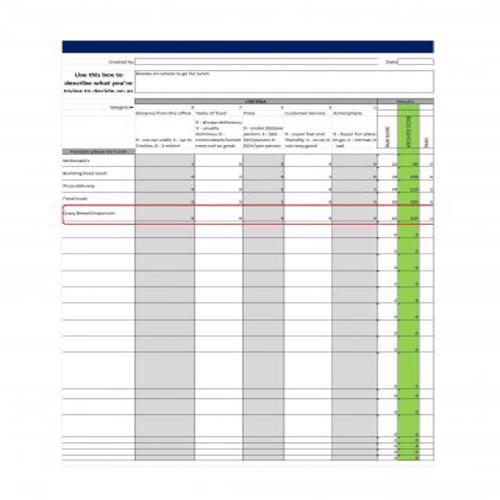
Weighted Decision Matrix Template

Example Decision Matrix Template

General Decision Matrix Template

Thorough Decision Matrix Template

Process of Decision Matrix
Following is the usual procedure of a decision matrix:
- Analyze the situation and set the evaluation criteria. If possible, you can also encourage customers to get involved.
- Discuss, review and amend the list of criteria. Feel free to add or remove criteria. Value the team’s suggestions and include the criteria that are important to the team.
- Carefully assign a relative weight to each criterion based on its importance. You can do this in either of the following two ways: 1- Based on team discussions and suggestions, distribute 10 points among the criteria. 2- Assign weights to each member and then the numbers for each criterion for a combined team weighting.
- Now draw the matrix. Write the criteria and their weights along one edge of the matrix and the list of options along the other edge.
- Now, evaluate each choice against the criteria.
- Finally, multiply each option’s rating by the weight and add up the points for every option. You don’t have to choose the option with the highest score, and the relative scores can also start useful discussions.
Handy Decision Matrix Templates
Analytical Decision Matrix Template

Particular Decision Matrix Template

Catchy Decision Matrix Template

Brief Decision Matrix Template

Detailed Decision Matrix Template

Standard Decision Matrix Template

Decision Matrix Format Template

Meticulous Decision Matrix Template

Intricate Decision Matrix Template

Sample Decision Matrix Template

Formal Decision Matrix Template

Evaluative Decision Matrix Template

Professional Decision Matrix

Itemized Decision Matrix Template

Typical Decision Matrix Template

Decision Matrix Worksheet Template

When a Decision Matrix is used?
A decision matrix is typically used in following circumstances:
- When a decision is to be made on the basis of different criteria
- When a single improvement opportunity or problem is required to be selected so as to work on it.
- When the list of options is reduced to one choice.
- When only one new product can be developed.
- When the list reduction tool is used in order to reduce the list of options to a manageable number.
- When only one solution or problem solving approach is available and it is to be implemented.
More Decision Matrix Templates
Informative Decision Matrix

Basic Decision Matrix Template

Sample Decision Matrix Template

Elementary Decision Matrix Template

Blank Decision Matrix Template

Vibrant Decision Matrix Template

Standard Decision Matrix Template

Official Decision Matrix Template

Typical Decision Matrix Template

Explicit Decision Matrix Template

Comprehensive Decision Matrix

Elaborative Decision Matrix Template

Pros and Cons of a Decision Matrix
Following are some of the common pros and cons of a decision matrix:
Pros:
- A decision matrix is very helpful when a decision is complex, has many possible outcomes and involves different criteria.
- A decision matrix divides and sub-divides the situation or task, thus making it easy to manage things.
- It provides an overall clear view of the circumstances.
Cons:
- The effectiveness of a decision matrix solely depends upon the information or data used.
- It is possible to easily manipulate or falsify the results or outcomes.
- It can be used to reach a specific, desired result, where the decision maker simply tries to justify a decision that has already been made.
Using a Decision Matrix Without False Precision
Choose criteria that relate to the decision and define the scoring scale. The matrix organizes judgment; it does not remove the need to examine assumptions. For an earlier qualitative comparison before weighted scoring, WordNExcelTemplates’ pros and cons chart template can help describe the trade-offs between options.
- Agree options, criteria and any non-negotiable requirements.
- Set weights and score options using a consistent evidence-based approach.
- Review the result and test whether reasonable changes alter the ranking.
Worked Example
Illustration: an option scoring 4 on a criterion weighted 0.6 contributes 2.4 to the weighted total. Check that higher scores always mean a better result. A low purchase price should not accidentally receive a low score merely because the raw number is small.
Common Mistakes to Avoid
Avoid double-counting overlapping criteria or choosing weights after seeing which option wins. Use sensitivity checks where the decision is important.
Related Templates
- Logic Model Templates
- Value Chain Analysis Templates
- Pareto Chart Templates
- Industry Analysis Templates
Frequently Asked Questions
Should the highest score automatically win?
Not necessarily. Check hard constraints, uncertainty and important factors the model may omit. Explain the final decision rather than treating arithmetic as authority.
How should weights be chosen?
Agree them before scoring, based on the decision’s priorities. Document the reasoning and test whether plausible alternative weights change the outcome.
