
A chart of accounts is an organized list of all the relevant accounts of a particular entity. For every account head, it includes the necessary details like type, description and amount etc. A chart of accounts is quite easy to prepare, but still, you can also use pre-formatted chart of accounts templates.
A chart of accounts template is an effective document that is used to obtain further necessary financial and other information of an entity. It is a quick and easy way to ascertain the financial status and financial position of an entity. For more details, make sure to scroll down and check out the given below chart of accounts templates.
Simple Chart of Accounts Templates
Chart of Accounts Template
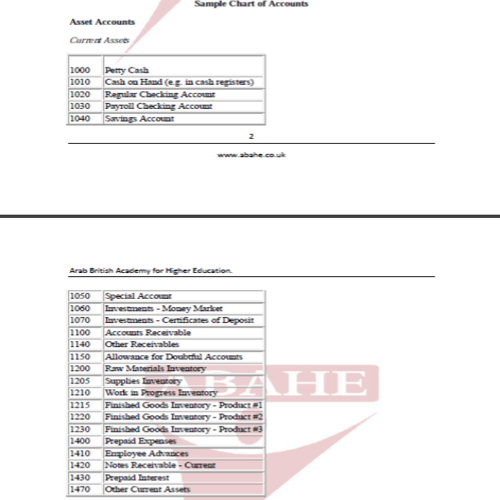
Chart of Accounts Template
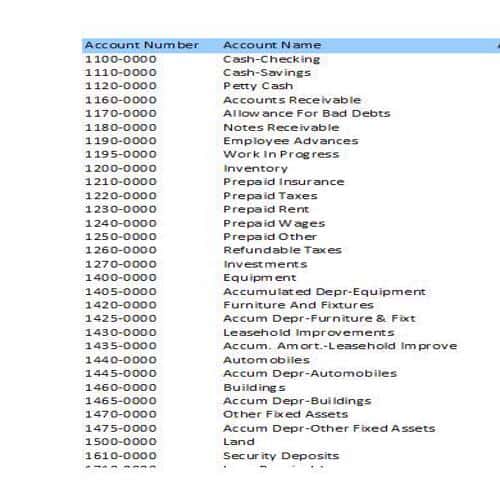
Chart of Accounts Template
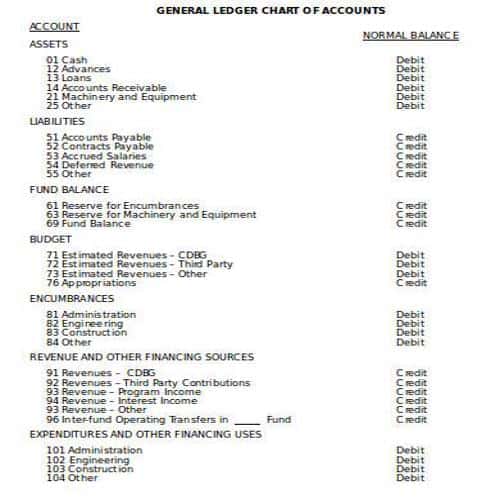
Chart of Accounts Template
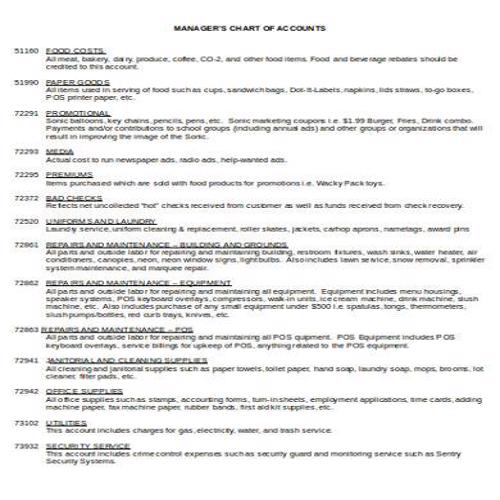
Chart of Accounts Template
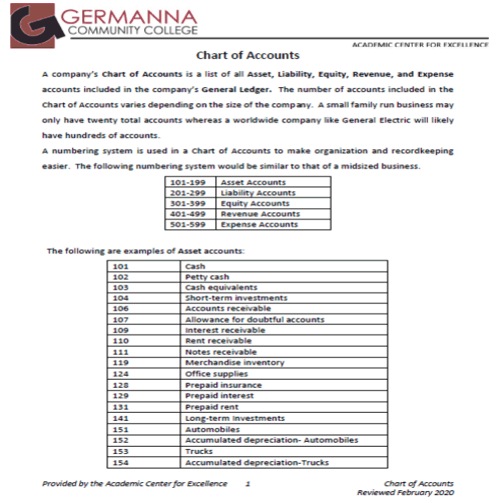
Chart of Accounts Template
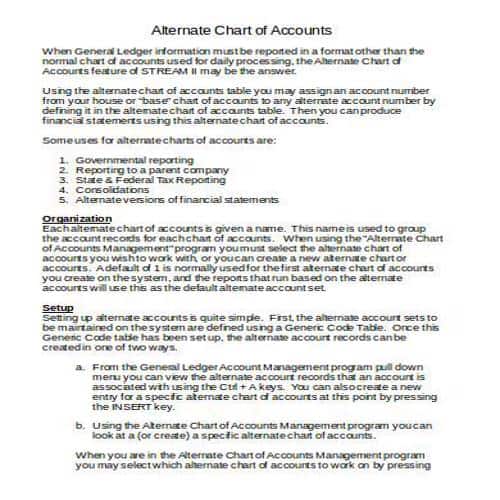
Chart of Accounts Template
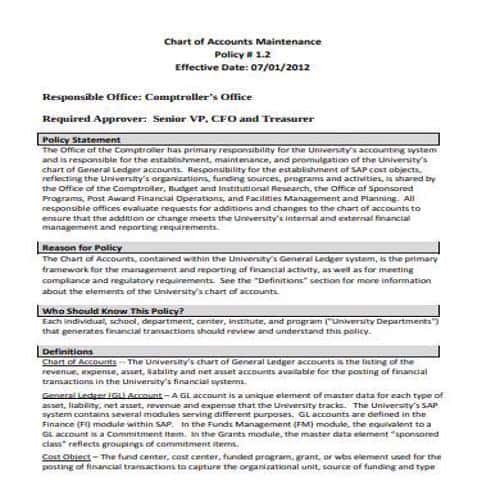
Chart of Accounts Template
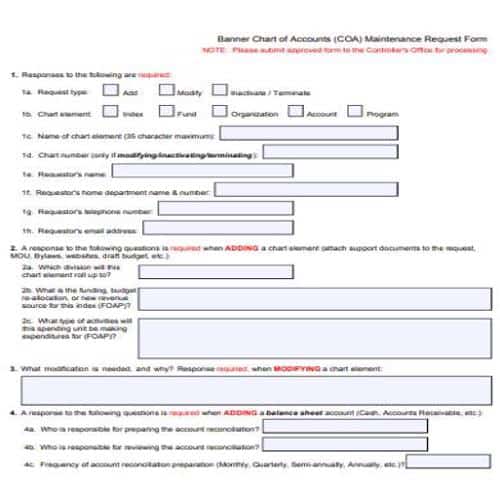
Chart of Accounts Template
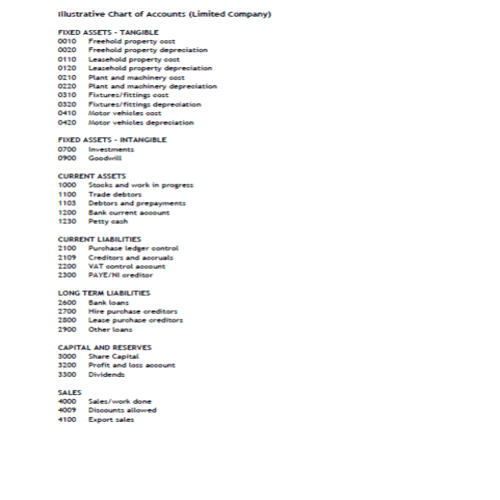
Chart of Accounts Template
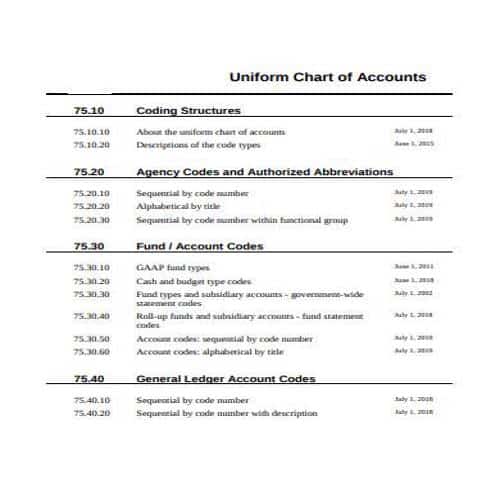
Setting up a Chart of Accounts
Setting up a Chart of Accounts is a simple process. The content and information included in a chart of accounts of a particular entity depends upon the type and nature of the entity and its business.
No matter how a chart of accounts is created, it includes at least following three columns:
- Account: Account heads or account names of the entity.
- Type: The type and nature of the account, i.e., asset, liability, income, expense or equity etc.
- Description: State the type of transaction that is usually recorded in the relevant account(s).
Remember to keep in mind that you can always include as many columns as you think would be necessary to make your chart of accounts more effective and informative.
In modern times, almost all of the entities use computerized systems for bookkeeping. In such systems, the computer automatically assigns specific numbers to all the account types or account heads. However, if an entity still uses a manual system of bookkeeping, it will have to manually assign such numbers to all the account types and account heads.
Usually, the following number system is used:
- Assets: From 1000 to 1999.
- Liabilities: From 2000 to 2999.
- Equity: From 3000 to 3999.
- Income/Revenue/Sales: From 4000 to 4999.
- Expense: From 5000 to 5999.
More Chart of Accounts Templates
Chart of Accounts Template
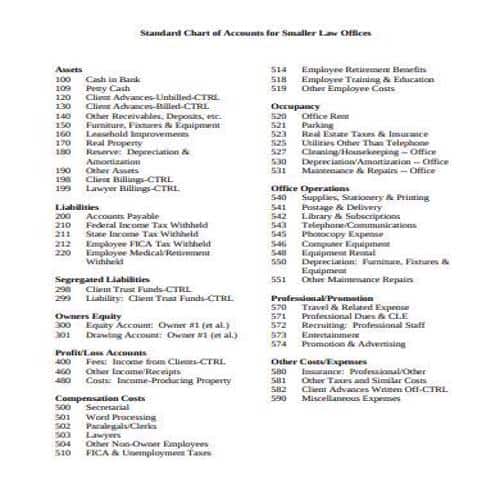
Chart of Accounts Template
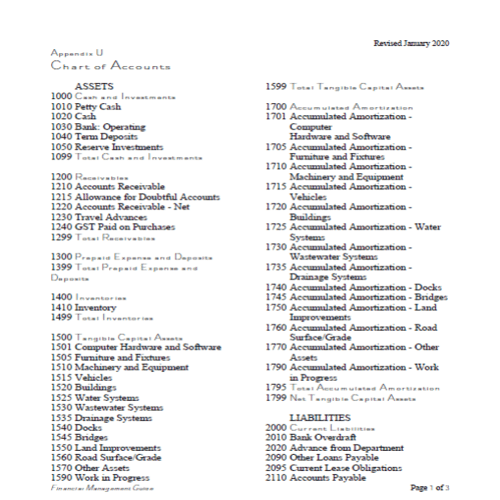
Chart of Accounts Template
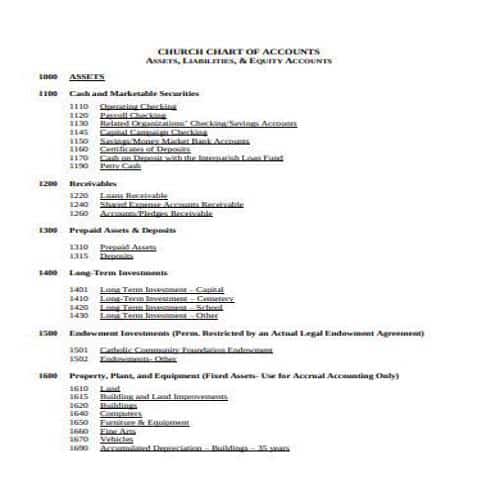
Chart of Accounts Template
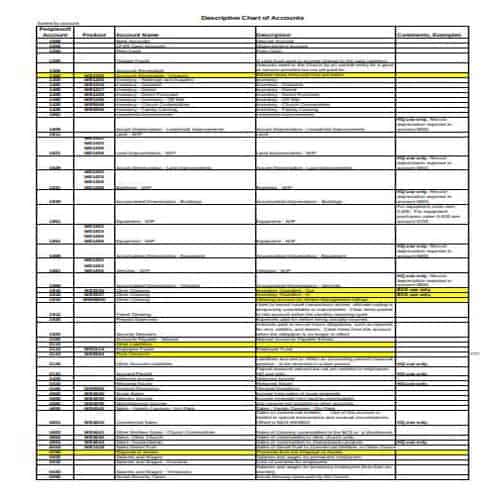
Chart of Accounts Template
Chart of Accounts Template
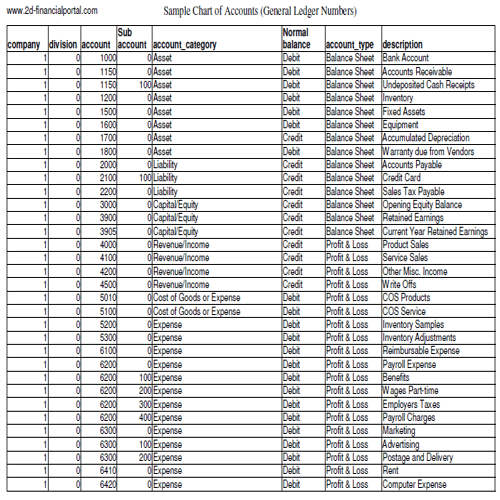
Chart of Accounts Template
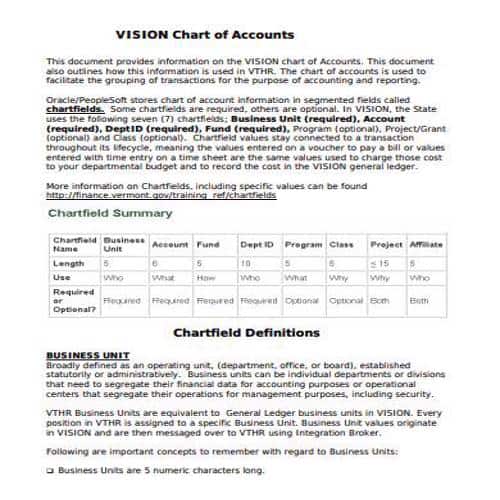
Chart of Accounts Template
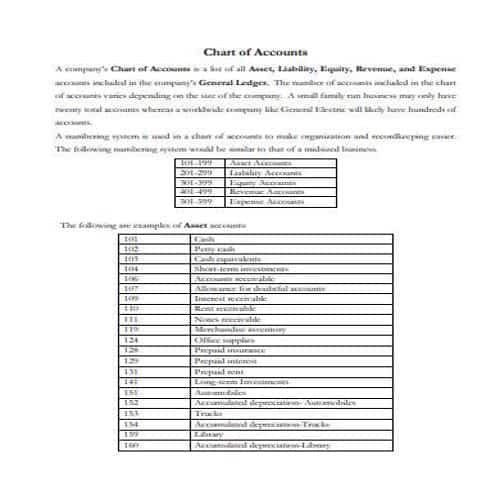
Chart of Accounts Template
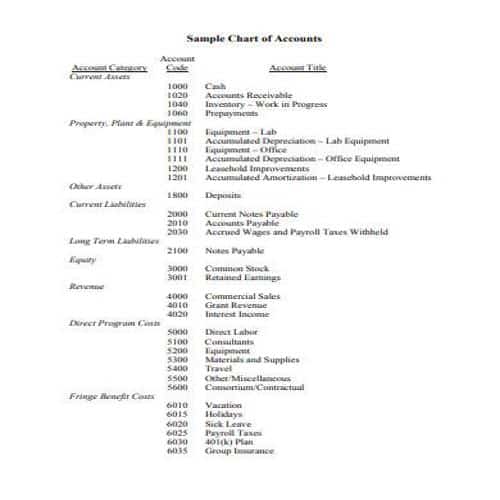
Chart of Accounts Template
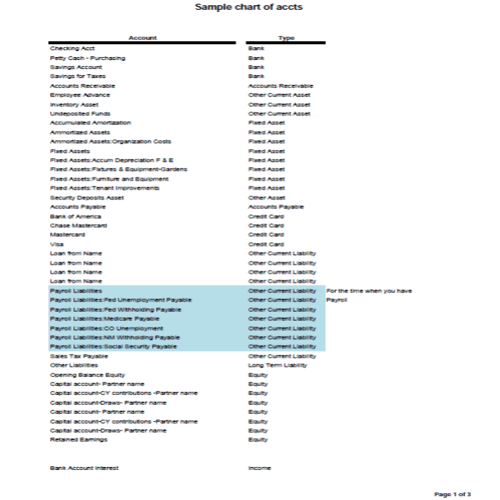
Chart of Accounts Template
Benefits of a Chart of Accounts
Following are some common benefits of a chart of accounts:
- A chart of accounts plays a very important role in the preparation of profit & loss statement and balance sheet.
- It minimizes the hard work and effort involved in integrating the information.
- It arranges the data and information in such a way so as to make it fairly easy to understand.
- With the help of a properly prepared chart of accounts, standard reports can be prepared on monthly or quarterly basis.
- The information is provided across all the departments of the entity on a consistent basis.
- It is also helpful in saving time and effort required for reconciliations.
- As each account type or account head is assigned a specific number, it is quite easy to extract any required information just by entering the number of the relevant account head.
FREE Chart of Accounts Templates: Practical Guide
These free chart of accounts templates are designed to help users produce a consistent, reusable document without starting from a blank page. A strong free chart of accounts template is more than an attractive layout: it should guide the user through the right information in a sensible order, make important details easy to verify, and produce a finished record that another person can understand without extra explanation.
Begin by reviewing the preview images and download options on this page. Choose the version that most closely matches your real purpose, software, paper size, and level of detail. Download a clean copy, save the original as a master, and edit a duplicate. This simple workflow protects the source file and makes later revisions much easier.
What to Include in a FREE Chart of Accounts template
The exact content depends on the situation, but a dependable editable business document normally needs the following information:
- A clear title and purpose. Add complete, current information and use the same terminology throughout the document.
- Accurate names, dates, and reference details. Add complete, current information and use the same terminology throughout the document.
- Logical sections and readable labels. Add complete, current information and use the same terminology throughout the document.
- Supporting facts, calculations, or instructions. Add complete, current information and use the same terminology throughout the document.
- Approval, signature, or review fields. Add complete, current information and use the same terminology throughout the document.
- A version date and storage reference. Add complete, current information and use the same terminology throughout the document.
Only retain sections that serve a genuine purpose. If a field is required but does not apply, use an approved notation such as “Not applicable” instead of leaving an unexplained blank. Where the document affects money, rights, employment, safety, or regulatory duties, have a qualified person review the customized version before it is issued or signed.
How to Choose the Best FREE Chart of Accounts template
Compare templates by substance before appearance. Check whether the structure reflects the actual workflow, whether the available fields are sufficient, and whether the file can be edited in the software you use. A shorter template that matches the task is usually better than a complicated design filled with irrelevant sections.
Also test practical details. Open the file, type realistic sample information, check tables and page breaks, verify that formulas or totals behave correctly, and print or export one test copy. If several people will use the document, ask someone unfamiliar with it to complete or review the test. Their questions often reveal unclear labels, missing instructions, or a poor sequence.
Step-by-Step Customization
- Define the purpose. Write one sentence describing what the completed free chart of accounts template must record, communicate, approve, or help someone decide.
- Select the closest layout. Match the sections and workflow first; fonts, colors, and branding can be adjusted later.
- Replace every sample entry. Verify spelling, dates, amounts, addresses, identifiers, and references against reliable source records.
- Adapt the structure. Add genuinely required fields, remove irrelevant clauses or columns, and arrange the content in the order users need it.
- Apply consistent formatting. Use clear heading levels, readable type, adequate spacing, aligned tables, and a restrained color palette.
- Review and approve. Assign a responsible person to check accuracy, completeness, calculations, and authorization.
- Control the final version. Use a descriptive filename, include the revision date when appropriate, and store the editable and final copies securely.
Common Mistakes to Avoid
The most common problems with free chart of accounts templates include unreplaced placeholders, inconsistent terminology, missing facts, weak formatting, unclear approval responsibility. Users also sometimes preserve instructions, example data, tracked changes, hidden comments, or blank pages from the source file. Complete a final content review and a separate visual review before distribution.
A template should not be presented as an official record from a bank, government office, court, school, employer, or other institution unless it has actually been issued or authorized by that organization. Do not add seals, signatures, certifications, or claims that could mislead the recipient.
Quality-Control Checklist
- Every placeholder, instruction note, and sample value has been replaced or removed.
- Names, dates, amounts, calculations, contact details, and references have been verified.
- Headings, labels, capitalization, numbering, and terminology are consistent.
- Required evidence, attachments, signatures, approvals, and submission details are identified.
- Links, formulas, tables, page numbers, margins, and page breaks have been tested.
- The final copy contains no comments, tracked changes, hidden data, or confidential examples.
Frequently Asked Questions
Are these free chart of accounts templates editable?
Yes. Use the available download format to change text, fields, tables, colors, and branding. Keep an untouched master copy so the original structure remains available.
Which format should I use?
Word is suitable for text-heavy documents and flexible page layouts. Excel is better for calculations, recurring logs, schedules, or structured data. PDF is useful for a final copy whose appearance should remain fixed. Choose the format offered by the specific download and appropriate to your workflow.
Can I use a downloaded free chart of accounts template for professional purposes?
It can provide a useful starting point, but it must be customized for the organization, transaction, audience, and applicable rules. Seek professional advice where legal rights, financial obligations, safety, compliance, or formal employment decisions are involved.
How do I make the document easier to complete?
Use short labels, plain instructions, a logical order, enough writing space, and examples only where they clarify the expected response. Mark mandatory fields consistently and avoid requesting information that is not needed.
What should I check before sharing it?
Proofread the wording, verify facts and calculations, test printing and links, confirm authorization, remove editing marks, and make sure the filename clearly identifies the approved version.
