
A patent agreement is a contract that sets out how the rights to a patent are licensed, sold or shared. Inventors use one to license an invention to a manufacturer for royalties, startups use it to buy patents, and employers use it to confirm that inventions made on the job belong to the company. Patent law differs by country, so have an IP lawyer review any agreement before signing.
This page has 18+ patent agreement templates, mostly PDF with one Word (.doc) file. You’ll find a standard and a simple patent license agreement, an exclusive license, a confidential patent purchase agreement, an invention patent agreement and a combined agreement and patent assignment. A broader intellectual property rights agreement covers deals involving more than one patent.
Decide first whether you’re licensing (keeping ownership) or assigning (giving it up), since that choice changes almost every clause, then pick the matching template.
Inventors often need to protect their work in other ways too. You may also need our confidentiality agreement templates before sharing an idea, copyright notice templates for written and creative work, and deal memo templates to outline licensing terms.
Patent License Agreement Template
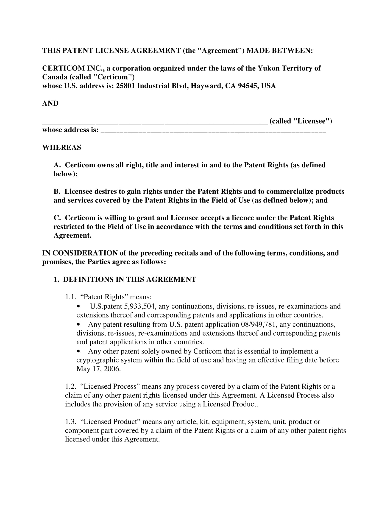

Confidential Patent Purchase Agreement Template

Exclusive Patent License Agreement Template
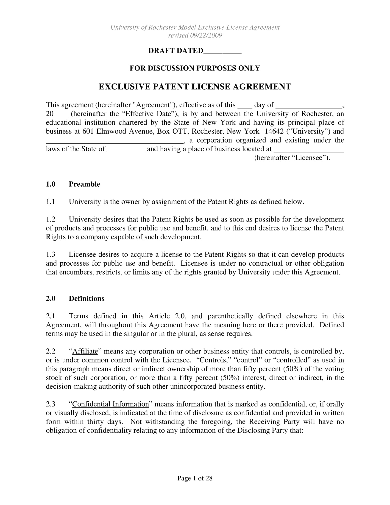
Invention Patent Agreement Template

Intellectual Property Rights Agreement Template

Standard Patent License Agreement Template
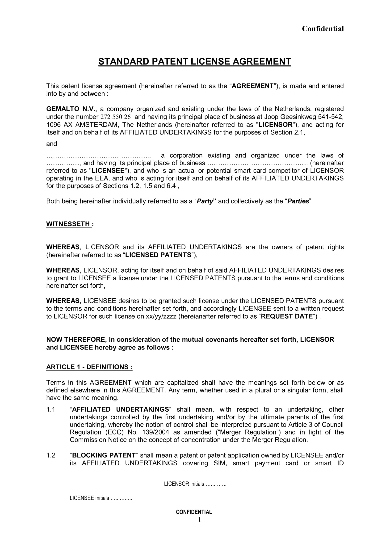
Patent Agreement and Assignment Template
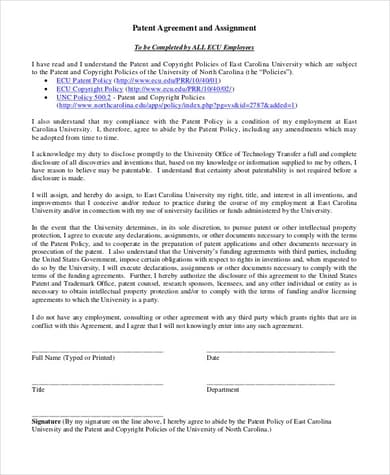
Simple Patent License Agreement Template

Exclusive Patent License Agreement Template

Sample Patent License Agreement Template
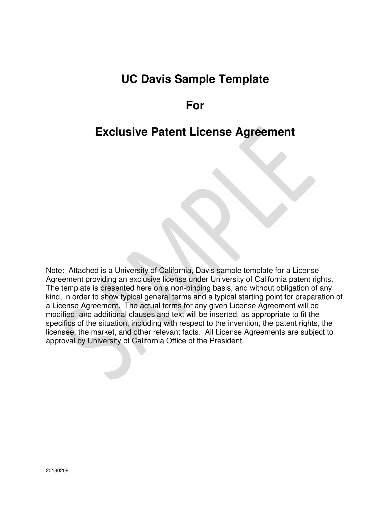
Typical Patent License Agreement Template
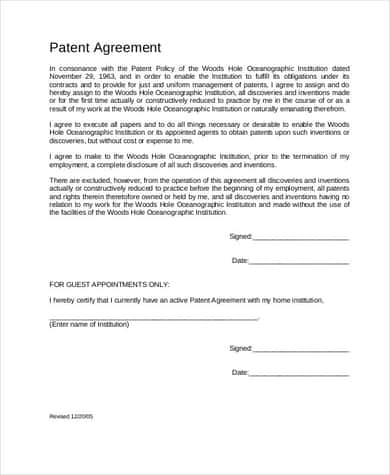
Patent Sub-License Agreement Template

Sample Patent and Copyright Agreement Template

Patent Security Agreement Template
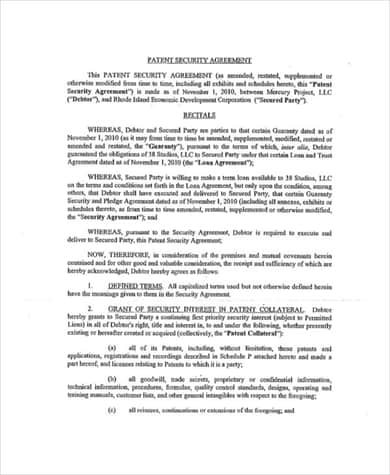
Agreement on a Unified Patent Court Template
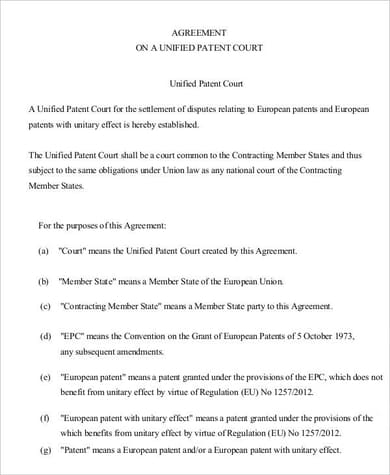
Employee Patent Agreement Template

Patent Sale Agreement Template

Patent Purchase Agreement Template

What to Include in a Patent Agreement
- Parties: patent owner and licensee or assignee
- Patent numbers and titles covered
- Licence or assignment of rights
- Field of use and territory
- Royalties, upfront fees and reporting
- Term, termination and confidentiality
Tips for Using These Patent Agreement Templates
Decide first whether you are licensing (granting use) or assigning (transferring ownership), as the templates differ. Patent agreements are technical; have a patent attorney review the final version.
How to Choose the Right Patent Agreement Template
Begin with the transaction, not the appearance of the form. A patent license agreement lets another party use defined patent rights while the owner normally keeps title. An assignment agreement transfers ownership of the rights covered by the agreement. A patent purchase agreement sets out the commercial terms of that transfer, often including payment, due diligence and closing requirements. A confidentiality agreement may be needed while the parties exchange technical information, but it does not grant patent rights by itself.
For a startup authorizing one manufacturer to produce a patented component, a license agreement may be appropriate if the startup wants to retain the patent. If the same startup sells the patent outright, it needs an assignment or purchase arrangement instead. The words “license,” “sale,” “security interest” and “assignment” are not interchangeable. Match the form to the actual business decision before editing a single clause.
Exclusive, Nonexclusive and Limited Licenses
An exclusive license can prevent the owner from granting competing licenses in the specified territory or field, depending on the contract. A nonexclusive license permits the owner to authorize more than one licensee. A limited license may cover only a product category, geographical area, customer segment or period. State these boundaries expressly: ambiguity about exclusivity, territory or sublicensing can become more expensive than the initial license fee.
Check whether the proposed agreement includes the right to sublicense, make modifications, outsource manufacturing or use related know-how. Patents and unpatented technical information can be governed by different rights. If an agreement mentions a “portfolio,” attach a schedule that identifies precisely which patents and applications it covers, including their jurisdictions and current status.
Patent Agreement Clauses to Review Before Signing
- Parties and authority: use full legal names, addresses and the correct company or individual signing capacity. Check that the party promising rights is entitled to grant or transfer them.
- Patent identification: list patent numbers, application numbers, titles, issuing countries and schedules. Confirm the record is current rather than relying only on a marketing description of the invention.
- Rights granted: spell out whether the recipient may make, use, offer for sale, sell or import the patented subject matter, as applicable to the relevant jurisdiction.
- Territory and field of use: define permitted markets and applications. A medical-device use and an industrial-equipment use may warrant different permissions and commercial terms.
- Exclusivity and sublicensing: explain whether anyone else can use the technology and whether the licensee can grant downstream rights to contractors, subsidiaries or distributors.
- Payments: specify upfront fees, milestone payments, running royalties, minimum guarantees, currency, invoice dates, reporting and any permitted deductions.
- Records and verification: describe what sales records must be kept, how long they are retained and whether the owner may review reported figures through an agreed audit process.
- Improvements: decide who owns later modifications, follow-on inventions and related inventions developed during the collaboration. Avoid assuming that the original patent clause answers this question.
- Maintenance and enforcement: allocate responsibility for renewal fees, prosecution of applications, infringement notices and decisions about litigation or settlement.
- Term and exit: address start date, expiry, early termination, cure periods, remaining inventory, post-termination sales and treatment of confidential materials.
How Patent Royalties and Payment Terms Work
Royalties can be calculated against units sold, defined net sales or another agreed measure. A percentage alone is insufficient: “5% of sales,” for example, leaves unanswered whether taxes, returns, freight, discounts and bundled products are included. The parties should define the royalty base and reporting period in the contract. A minimum annual royalty sometimes encourages an exclusive licensee to commercialize the invention, but it can also create costs during a slow launch. The appropriate structure depends on the business and the value of the rights being licensed.
Consider a fictional manufacturer that will pay a fixed upfront license fee plus a royalty on qualifying sales. The agreement should state when reports are due, what a qualifying sale means, whether related-company transfers count and how disputed calculations will be checked. If product development requires regulatory approval, the parties might also negotiate milestone dates and the consequences if approval or a launch does not occur. Avoid inserting made-up percentages or industry norms into a finished agreement without negotiation.
Step-by-Step: Customize a Downloaded Patent Agreement
- Confirm the deal type. Write one sentence describing who owns the patent today and what rights the other party should have after signing. If that sentence does not match the template title, select a different form.
- Prepare a patent schedule. Gather patent and application identifiers, owners, countries, expiry and maintenance information. Independently verify ownership and status with the appropriate official registry where possible.
- Identify commercial boundaries. Record permitted products, territory, customers, sublicensing, duration and exclusivity. Replace generic placeholders with carefully defined terms.
- Agree on consideration. Document fees, royalties, reporting, invoice procedures, tax responsibilities and the treatment of late payments.
- Review risk allocation. Check representations, warranties, limitations of liability, confidentiality, disputes and responsibility for third-party claims. The fact that a template includes a clause does not mean its allocation is suitable.
- Obtain professional review. A qualified patent lawyer can help confirm whether local formalities, recordation, tax treatment or competition-law concerns affect the proposed transaction.
- Sign and retain records. Keep the executed agreement, attachments and later amendments together. Establish a reminder system for reporting dates, renewal deadlines and negotiated milestones.
Common Patent Agreement Mistakes
Confusing ownership with permission: a patent license does not normally transfer title, whereas an assignment does. A form labeled “agreement” without a clear grant clause may not capture either arrangement adequately. Ignoring jurisdictions: rights are territorial, so a patent granted in one country does not automatically provide protection everywhere. Omitting background technology: a patent may not cover source code, drawings, trademarks, trade secrets or know-how needed to manufacture a product. Those assets may need separate contractual treatment.
Using inconsistent attachments: an exhibit with the wrong patent number or an outdated owner can undermine an otherwise careful contract. Leaving payment terms vague: undefined net sales, costs or milestones invite disagreements. Failing to plan for expiration: the parties should understand which rights cease when a patent expires and what separate duties may survive. Review any obligations that last beyond termination, including record retention, confidentiality and unpaid fees.
A Practical Review Example
Suppose an inventor wants a factory to manufacture a specialized tool for three years in one country. A useful license should identify the patent, authorize the manufacturing and sales activities that are actually needed, describe whether the factory has exclusive rights and specify how the inventor is paid. It may also address quality requirements, reporting, subcontractors and ownership of improvements. If the inventor instead intends to sell all patent rights permanently, a license template is not the correct starting point. These two scenarios illustrate why the subject matter of the agreement matters more than its visual design.
These downloadable forms are starting points for organizing information, not a determination that a particular transaction is lawful or enforceable. Patent transactions can involve registration, employee-invention rules, cross-border payments and intellectual property issues that are not resolved by a generic template. When significant money or valuable inventions are involved, have a professional review the final documents.
Quick Checklist Before Choosing a Patent Document
Use the template that fits the underlying activity and the information you actually need to record. Here are practical distinctions that help when reviewing the available designs:
Patent licensing
Confirm that permission to use the invention is intended without transfer of ownership.
Patent assignment
Check that the parties intend an ownership transfer and identify the relevant patent rights.
Confidential disclosure
Use a confidentiality agreement when sharing nonpublic technical information before negotiations.
Cross-border transaction
Check territorial scope, local formalities and possible recordation rules.
Before You Finalize the Template
- Verify the patent number and the actual legal owner.
- State permitted activities, territory and duration explicitly.
- Define payment, improvements and termination terms.
- Seek jurisdiction-specific legal review before signing.
Related Templates
- Copyright Notice Templates
- Confidentiality Agreement Templates
- Privacy Policy Templates
- Deal Memo Templates
Frequently Asked Questions
How is a patent licence different from an assignment?
A licence grants specified permission to use rights, while an assignment transfers an ownership interest. The scope, territory, term and formalities need careful review, and a general sample cannot establish what rights a party actually owns.
How should royalties be defined?
State the calculation basis, rate, exclusions, reporting, payment timing and treatment of adjustments. A percentage alone does not explain whether it applies to gross receipts, defined net sales, units or another measure.
What should I verify before relying on a patent agreement?
Check the relevant patent rights, ownership and authority, scope of the proposed transaction and applicable requirements. Obtain appropriate specialist advice, particularly for valuable inventions, cross-border use or disputed rights.
