
A risk register is a log of the risks that could affect a project or business, with a rating, an owner and a plan for each one. It keeps every known risk in one place so nothing is forgotten between meetings. Project managers, safety officers, auditors and company boards use one to track risks from first identification to closure.
The collection holds 37 risk register templates, editable and free to download. They include a risk register format for quick setup, a detailed register with likelihood and impact scoring, an analytical version and a company-wide risk management register. Each serves as a project risk register or a risk log template.
Write every risk as cause, event and effect, for example “Supplier delay leads to late delivery, which causes penalty fees”. That format makes the risk clear enough for an owner to act on, and it stops vague entries like “budget” from cluttering the register.
A risk register is easier to fill in once you have done a risk analysis. You can also check out our contingency plan templates for response plans and meeting minutes templates to record risk review meetings.
Useful Risk Register Templates
Risk Register Format Template
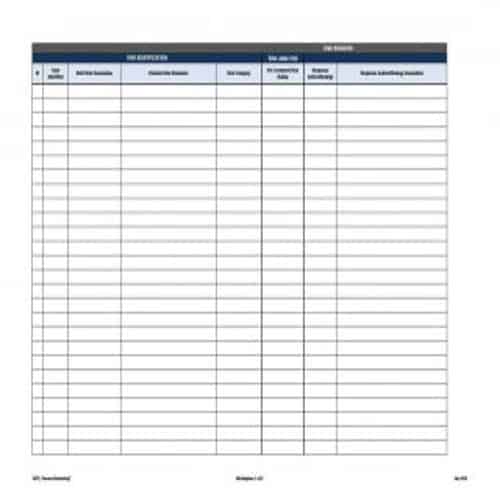
Detailed Risk Register Template

Company’s Risk Register Template
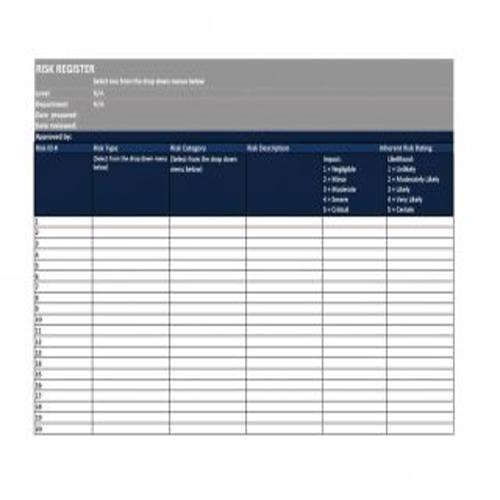
Specific Risk Register Template

Official Risk Register Template

Catchy Risk Register Template

Risk Management Register Template

Analytical Risk Register Template

Construction Risk Register Template

Important Risk Register Template

Typical Risk Register Template

Daily Risk Register Template

New Risk Register Template

Basic Elements of a Risk Register Template
Following are some of the very basic and common elements of a risk register template.
1. Identification:
Each and every potential risk or threat must be properly identified. Where possible, each risk must be identified numerically.
2.Risk Explanation:
Every potential risk, threat or issue must be properly analyzed, explained and addressed in a risk register template.
3. Triggers of Risk:
A risk register template should also include the reasons that cause such risks to occur.
4. Chance of Risk:
The probability of each risk must be properly assessed. It is often shown as a percentage, for example a 50% probability that a certain risk will occur.
5. Effect of Risk:
In a risk register template, the impact of each individual risk must be clearly stated. The impact of each risk should be rated as high, medium or low.
6. Risk Score:
Where applicable, each risk should be given a score using a numerical rating system, by multiplying probability by impact.
7. Person Accountable:
Risk register template should clearly indicate the person that is accountable for the risk management.
8. Steps for Mitigation:
The risk register template must clearly state the steps or solutions planned to mitigate the identified risks or threats.
9. Remaining Risk:
After a certain risk is dealt with, the remaining risk, if any, must be explained.
10. Accepted Probability:
After a risk is reduced to a certain level, the probability of the residual risk is often called the ‘accepted probability’. It indicates that this level of risk is acceptable.
11. Accepted Impact:
The impact or effect of a certain risk that is acceptable, after it has been dealt with.
Effective Risk Register Templates
Special Risk Register Template

Formal Risk Register Template

Simple Risk Register Template

Unique Risk Register Template

Blank Risk Register Template

Explicit Risk Register Template
Elemental Risk Register Template

Assignment’s Risk Register Template

Event’s Risk Register Template

Ideal Risk Register Template
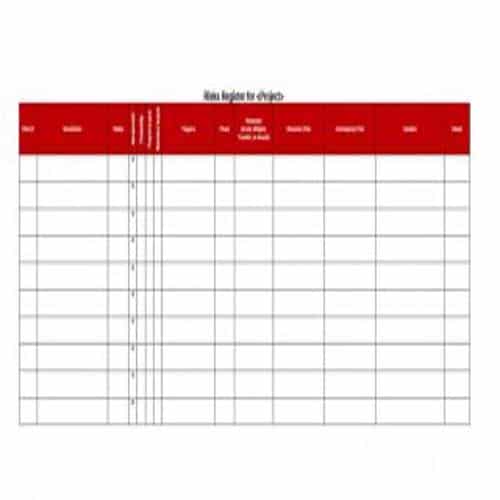
Exclusive Risk Register Template

University’s Risk Register Template

Benefits of a Risk Register Template
Some of the common benefits of a risk register template are:
- It helps to achieve consistency in the operations or projects of a business.
- It is a tool that is used to record or document the potential risks and prepare for them.
- A risk register template provides a straightforward framework that is easy to understand and manage, and helps achieve a certain level of quality.
- It lets you assign the right individuals or teams to deal with potential risks.
- With a standard risk register template, you can see all potential issues at a glance and get an overall picture of the current situation.
- Breaking down the complex data into compact and useful information helps avoid any confusions and misunderstandings.
- A risk register template makes you record information concisely. It includes only the information that is actually needed, with nothing irrelevant.
- A risk register allows everyone to help identify and manage potential risks. Identifying and managing potential threats is not just the job of a manager or leader.
- Even if no risk occurs at all, a risk register template can still be used in any future projects.
More Risk Register Templates
Risk Management Log Template

Simplified Risk Register Template

Particular Risk Register Template

Handy Risk Register Template

Comprehensive Risk Register Template

Straight-forward Risk Register Template

Professional Risk Register Template

Practical Risk Register Template

Typical Risk Register Template

Drafted Risk Register Template

Specific Risk Register Template

Extensive Risk Register Template

Making a Risk Register Actionable
Choose a register with enough detail to connect each risk to an owner and response. A longer list is not necessarily better if nobody reviews the entries. If a recorded risk becomes an actual incident, WordNExcelTemplates’ incident report templates can help document the event while the risk register tracks the resulting actions.
- Describe the uncertain event, its cause and its effect on the objective.
- Rate likelihood and impact using defined scales, then assign an accountable owner.
- Record the response, due date, trigger and next review date.
Worked Example
Example: “Supplier delay” is vague. A clearer entry states that a late delivery of the control unit could delay commissioning by a week. The owner confirms the supplier date, identifies an alternative and watches for a missed dispatch notice. The trigger tells the team when to act.
Common Mistakes to Avoid
Do not confuse a risk with an issue that has already occurred. Keep initial and residual ratings distinct and explain any rating change.
Related Templates
Frequently Asked Questions
What is residual risk?
It is the risk remaining after a response or control is considered. Record which action supports that assessment; an unfinished action should not automatically justify a lower rating.
How often should risks be reviewed?
Use the project’s pace and exposure to set a review cycle, and review sooner when triggers, assumptions or circumstances change.
